
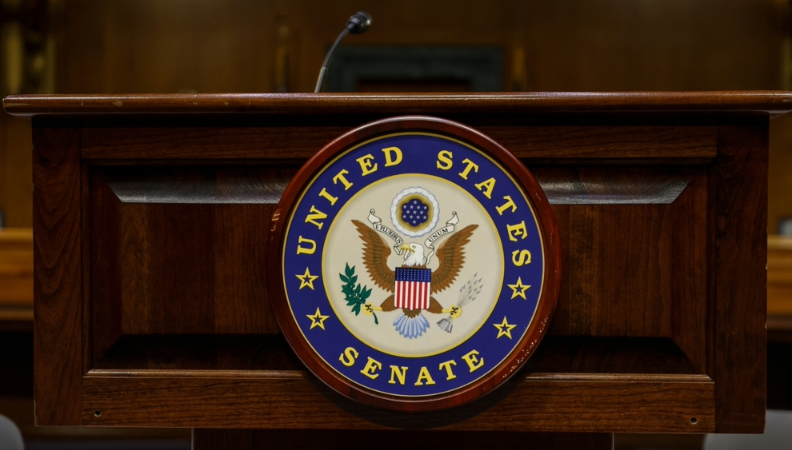
Sen. Mike Lee, R-Utah, is leading a bipartisan congressional effort to reauthorize a legal provision with additional safeguards to prevent the government’s surveillance of Americans’ digital data without a warrant.
Lee and cosponsor Sen. Dick Durbin, D-Ill., introduced the Security and Freedom Enhancement (SAFE) Act on Monday to reauthorize Section 702 of the Foreign Intelligence Surveillance Act (FISA) and reinforce safeguards protecting Americans’ privacy and civil liberties.
Section 702 is a 9/11-era U.S. law that authorizes the government collection of foreign intelligence by targeting non-U.S. persons abroad, including by requiring U.S. companies to provide certain communications tied to suspected terrorists.
Congress has until April 20 to reauthorize the law. However, the law itself has been controversial. While Congress explicitly prohibited the targeting of Americans under Section 702, the FBI conducted up to 3.4 million warrantless searches of Section 702-related communications to collect Americans’ information, according to an Office of the Director of National Intelligence report.
Lee and Durbin’s proposal would tighten protections for Americans compared to the current law. Most notably, it would require the government to obtain a Title I FISA order or warrant before accessing the content of Americans’ communications returned in U.S.-person queries, while leaving foreign-target searches unchanged.
It also adds formal exceptions – such as cybersecurity – and strengthens oversight by expanding the role of FISA Court amici and adding internal review requirements, restricting agencies’ ability to buy Americans’ sensitive information from brokers, and narrowing the definition of “electronic communications service provider.”
Additionally, it would formally bar the government from continuing to use or reinterpret the expired Section 215 authority “loophole” to collect records, closing off a surveillance tool that lapsed in 2020.
“The many documented abuses under FISA should provoke outrage from anyone who values the Fourth Amendment,” Lee said in a statement. “From warrantless searches targeting journalists, political commentators, and campaign donors to monitoring sitting members of Congress, these infringements reveal a blatant disregard for individual liberties.”
Durbin added that under the new proposal, Section 702 would “continue protecting our country from foreign threats – while safeguarding Americans’ civil liberties and privacy.”
Sens. Kevin Cramer, R-N.D., and Mazie Hirono, D-Hawaii, have also joined the proposal as cosponsors, but the bill is likely to face some resistance in gaining enough support to pass from the Trump administration.
So far, the revamped legislation has received praise. Jake Laperruque, deputy director of the Center for Democracy and Technology’s Security and Surveillance project, joined more than two dozen organizations in pushing for some of the safeguards covered by the bill.
“FISA 702 has been abused in shocking ways,” Laperruque said in a statement. “The SAFE Act includes bold FISA reforms, creates strong guardrails against surveillance misconduct, and has been meticulously crafted to protect national security. With less than 10 weeks until FISA 702 expires, Congress should take up reform legislation quickly. Kicking the can on FISA would be a dereliction of duty.”